Panchakarma & therapies

Sixteen therapies,
and what each one is for.

Ayurveda does not have one treatment that it gives to everybody. The doctor selects from these according to your constitution and the imbalance behind your symptoms — usually several of them, in sequence, over a course of days.

Panchakarma

The cleansing actions

The classical detoxification of Ayurveda. These are courses of treatment, prepared for over several days and given under the doctor’s supervision — not single appointments.

  • Virechana Purgation therapy

    The process by which bodily wastes are evacuated through the lower pathway of the body.

    Virechana is one of the five classical cleansing actions of Panchakarma. Preparation with internal and external oleation and steam loosens the accumulated doshas; a measured herbal purgative then clears them downwards through the intestinal tract.

    Used for
    • Skin diseases
    • Obesity
    • High cholesterol
    • Hormonal imbalance
    • Piles
    • Gout
    • Jaundice
    • Hyperacidity
    • Constipation
    • Irritable bowel syndrome
  • Basti Medicated enema

    Medicated enema used to cleanse and purify the colon, and to nourish the body.

    Operating in the colon, Basti is used to maintain or restore equilibrium of the nervous system. It is considered the single most effective treatment for disorders of Vata, and is given as a course rather than a single session.

    Used for
    • Sciatica
    • Arthritis
    • Rheumatism
    • Gout
    • Sexual disorders
    • Kidney stones
    • Backache
    • Neck pain
    • Paralysis
    • Kidney failure
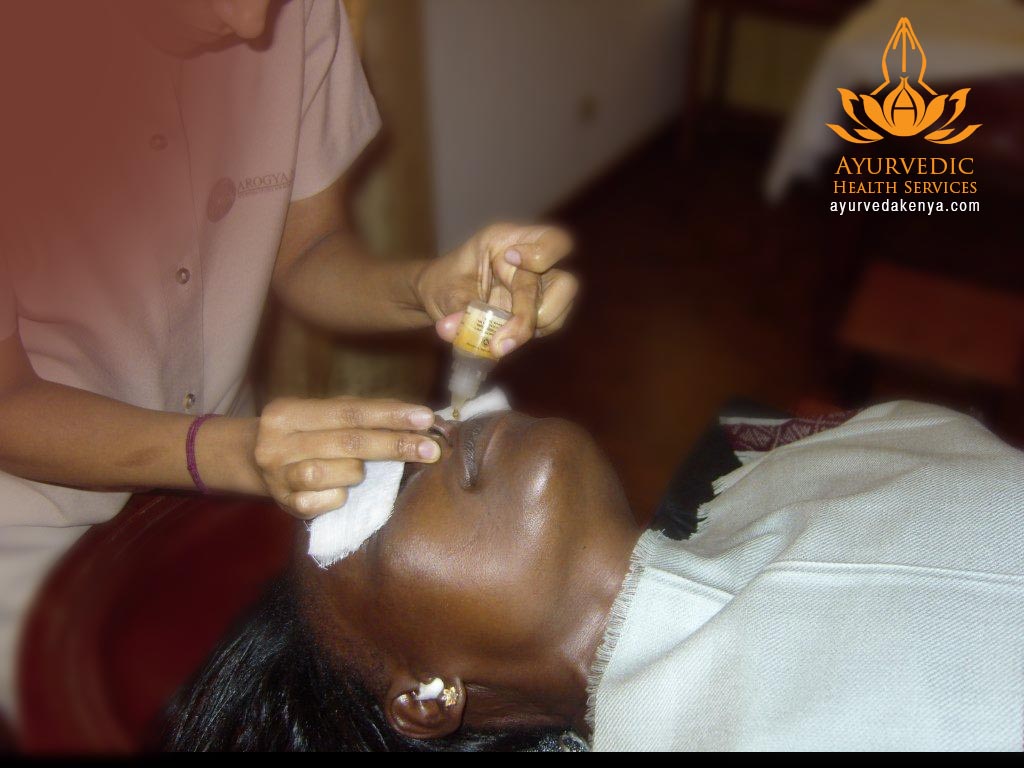
  • A therapist instilling medicated oil into a patient’s nostril during Nasya

    Nasya Nasal infusion

    Medicine introduced through the nostrils to clear the passages of the head and neck.

    The nose is understood in Ayurveda as the doorway to the head. Warm medicated oils or decoctions instilled into the nostrils, after gentle facial massage and steam, act directly on the sinuses, eyes, ears and the nervous system.

    Used for
    • Diseases of the eyes
    • Nose and ear complaints
    • Migraine
    • Headache
    • Sleep-related problems
    • Hair problems
    • Disorders of the brain and nerves
Retained heat

Localised oil and heat

Warm medicated oil held against one part of the body inside a ring formed on the skin. Where a joint or a stretch of spine is the problem, the treatment goes to it directly.

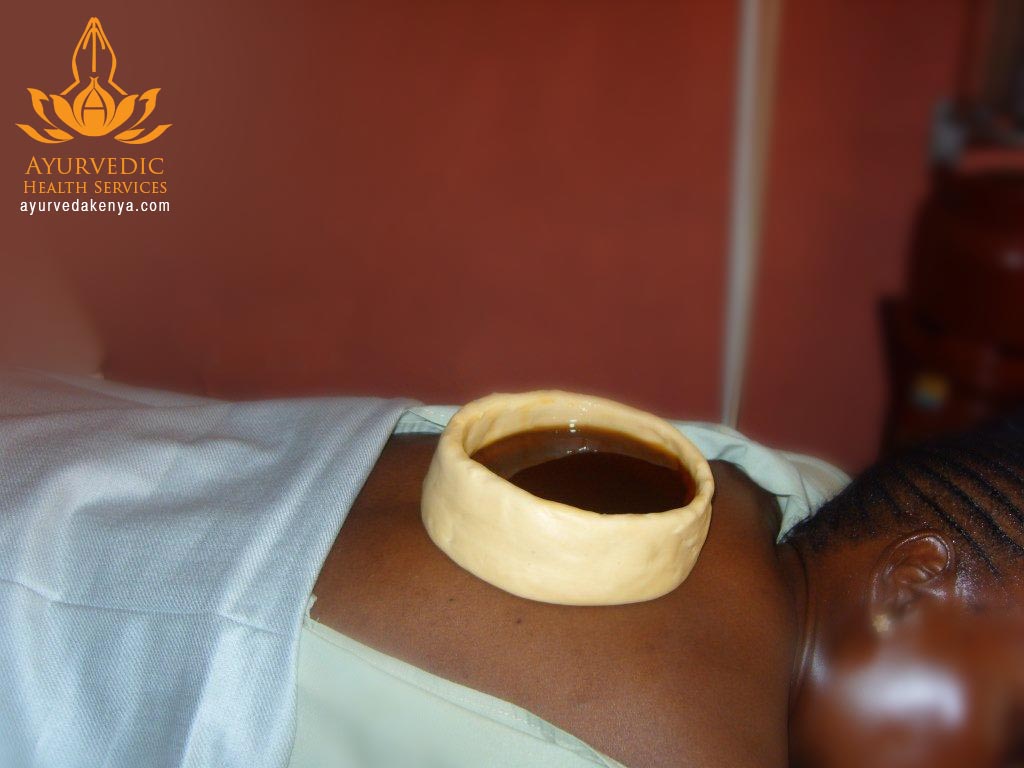
  • Warm medicated oil held in a dough ring over a patient’s lower back

    Kati basti Heat therapy for the lower back

    Warm medicated oil held over the sacral and lumbar region inside a specially formed ring.

    A ring of dough is built on the lower back and filled with warm medicated oil, which is kept at temperature for the length of the session. The heat and the oil work together on the muscles, discs and nerves beneath.

    Used for
    • Backache
    • Lumbar spondylitis
    • Sciatica
    • Slip disc
  • Griva basti Heat therapy for the neck

    The same retained-oil technique applied to the cervical region.

    Warm medicated oil is retained over the back of the neck within a specially formed ring, softening the muscles around the cervical vertebrae and easing pressure on the nerves leaving them.

    Used for
    • Cervical spondylitis
    • Slip disc
    • Osteoarthritis of the cervical vertebrae
  • Janu basti Heat therapy for the knee

    Warm medicated oil retained over the knee joint.

    A ring is formed around the knee and filled with warm medicated oil. The therapy is used where the joint is degenerating rather than acutely inflamed, and is normally given daily over a course.

    Used for
    • Osteoarthritis of the knee joint
    • Degenerative changes of the knee joints
  • Warm medicated oil held in a ring over a patient’s chest

    Hridaya basti Heat therapy for the chest

    Warm medicated oil retained over the cardiac region.

    Applied over the centre of the chest within a formed ring, Hridaya basti is used to strengthen the heart and to ease the muscular and respiratory structures around it.

    Used for
    • Heart problems
    • Asthma
    • Bronchitis
    • Costochondritis
Body & skin

Massage, plaster and rejuvenation

Whole-body therapies — some nourishing, some deliberately reducing — along with the classical treatments for the skin of the face.

  • Pizhichil The oil bath

    Lukewarm herbal oil poured over the whole body by two to four therapists at once.

    Two to four trained therapists pour lukewarm herbal oils over the entire body in a continuous rhythmic pattern, for sixty to ninety minutes a day across a course of seven to twenty-one days. It is the most intensive of the rejuvenation therapies offered here.

    Used for
    • Rheumatic diseases such as arthritis
    • Paralysis
    • Hemiplegia
    • Paralysis agitans
    • Sexual weakness
    • Nervous weakness and nervous disorders
  • Pinda Sweda Bolus massage

    A hot bolus of medicated black gram worked over the body below the neck.

    Black gram is cooked with specific herbs and tied into a bolus, which is then rubbed vigorously over the whole body below the neck, concentrating on the muscle tissue and the joints.

    Used for
    • Joint pains
    • Paralysis
    • Muscle atrophy
    • High blood pressure
    • High cholesterol
    • Loss of libido
    • Rejuvenation of the skin
  • Udavartana Powder massage

    Massage with herbal powder worked against the direction of the body hair.

    The body is massaged with oil or herbal powder in the direction opposite to the lie of the hair. The friction is deliberate: it is the reducing therapy, used where the aim is to break down rather than to nourish.

    Used for
    • Excess body fat
    • Overweight
    • Poor skin integrity
    • Unsteadiness in the body
    • Body odour
  • Mukhalepa Ayurvedic facial

    Medicated gel, steam, exfoliation and a herbal plaster applied to the face.

    A facial massage with medicated gel is followed by medicated steam, then exfoliation with a powder massage, and finally a thick plaster of medication applied over the whole face and left to set.

    Used for
    • Wrinkles
    • Pimples
    • Dark spots
    • Hyperpigmentation
    • Premature ageing
Why these, and why in this order

The reasoning underneath

Ayurveda works from a small set of ideas. You do not need to accept them for the treatment to help, but they explain why two people with the same diagnosis are rarely given the same therapy.

Tridosha

Three working energies

Vata air + space
Energy, respiration, movement, and the act of elimination.
Pitta fire
Vision, digestion, body temperature, thirst and hunger, complexion, intelligence.
Kapha water + earth
Lubrication, steadiness, strength, patience.

Whichever predominates gives your prakriti — Vata, Pitta or Kapha constitution. It is established at your first consultation and it does not change.

Saptadhatu

Seven body tissues

Rasa plasma
Nourishment
Rakta blood
Life
Mamsa muscle
Covering
Meda fat
Lubrication
Asthi bone
Structure
Majja marrow
Feeling
Shukra reproductive
Progeny

In health the doshas and the dhatus together keep the body growing and working. Vitiated, they are where disease begins.

Two approaches

Pacify, or clear out

Shaman — pacifying

Where the disturbance is mild. Treatment is with herbs, minerals and metals chosen to settle the vitiated dosha, with no adverse reaction.

Shodhan — cleansing

Where it is more than mild: Panchakarma. Herbal medicine, medicated oils and ghee are used to carry the vitiated doshas out of the body altogether. Healthy people use it too, to stay well.

Ayurveda is not simply a health care system but a form of lifestyle adopted to maintain perfect balance and harmony within human existence.
Begin

Not sure which of these you need?

That is what the first consultation is for. The doctor establishes your constitution and the cause behind the symptoms, then builds the course from there.